










What Size Surfboard Should You Buy?
Wondering what size surfboard you should get? There are more than a few factors we must consider when answering this notoriously slippery question.
The quick answer, however, is this.
Beginner surfers should choose a larger board with more volume, generous length and extra width and thickness. These features help deliver more stability, better buoyancy and easier paddling — all so you can catch waves with less effort and build confidence quickly.
That said, the topic is extremely nuanced. And most surfers actually pick the wrong size surfboard due to a lack of knowledge.
In this guide, we’ll walk you through all the important factors, from body weight and fitness to wave conditions and surfboard shapes, to help you choose the right surfboard and maximise your fun in the water.
Check out our full surfboard collection for a wide range of beginner-friendly boards.
Key Beginner Surfboard Buying Factors
Wondering to yourself, “What size surfboard should I get?”. Here are the key beginner surfboard buying factors that you should consider.
Your Fitness Levels
Surfing is physical. If you have limited paddle fitness or are just starting out, you’ll struggle on a low-volume, bladey or thinner board.
Boards like this require more paddle power. And that can lead to you missing waves or burning out before your pop-up moment arrives. That’s why we recommend super stable surfboards with more volume to beginner surfers. They’re easier to paddle, float better, and help you get into waves sooner.
The Types of Waves You’ll Surf
Surf conditions matter. Will you be surfing small waves at your local beachie or occasionally taking on medium to large waves at a rogue East Coast reef break?
- Small-sized waves (knee to waist high): Require a bigger board with extra flotation to keep your wave count high.
- Medium-sized waves (chest to overhead): Suit performance or mid-length boards that balance stability with manoeuvrability.
- Bigger waves (overhead to double overhead): Are better suited to volume-up-front boards with sharper rails and plenty of rocker. Only for more experienced surfers with sharper turning skills.
Always match your board size to the wave size and factor in your ability to handle it. While expert surfers can get away with surfing different shapes and board types in any-sized surf, beginners need a board specifically suited to the conditions.
Your Body Type
Your body weight and height directly affect the surfboard size you’ll need.
- Heavier surfers benefit from larger boards with higher volume for improved float and balance.
- Likewise, taller individuals may need longer boards to match their proportions and keep things super stable.
- Lighter or shorter surfers can look at shorter boards, but beginners should still prioritise volume.
- Ultimately, you want something that floats you and therefore allows you to paddle and catch waves easily.
What Length Surfboard Should You Get?
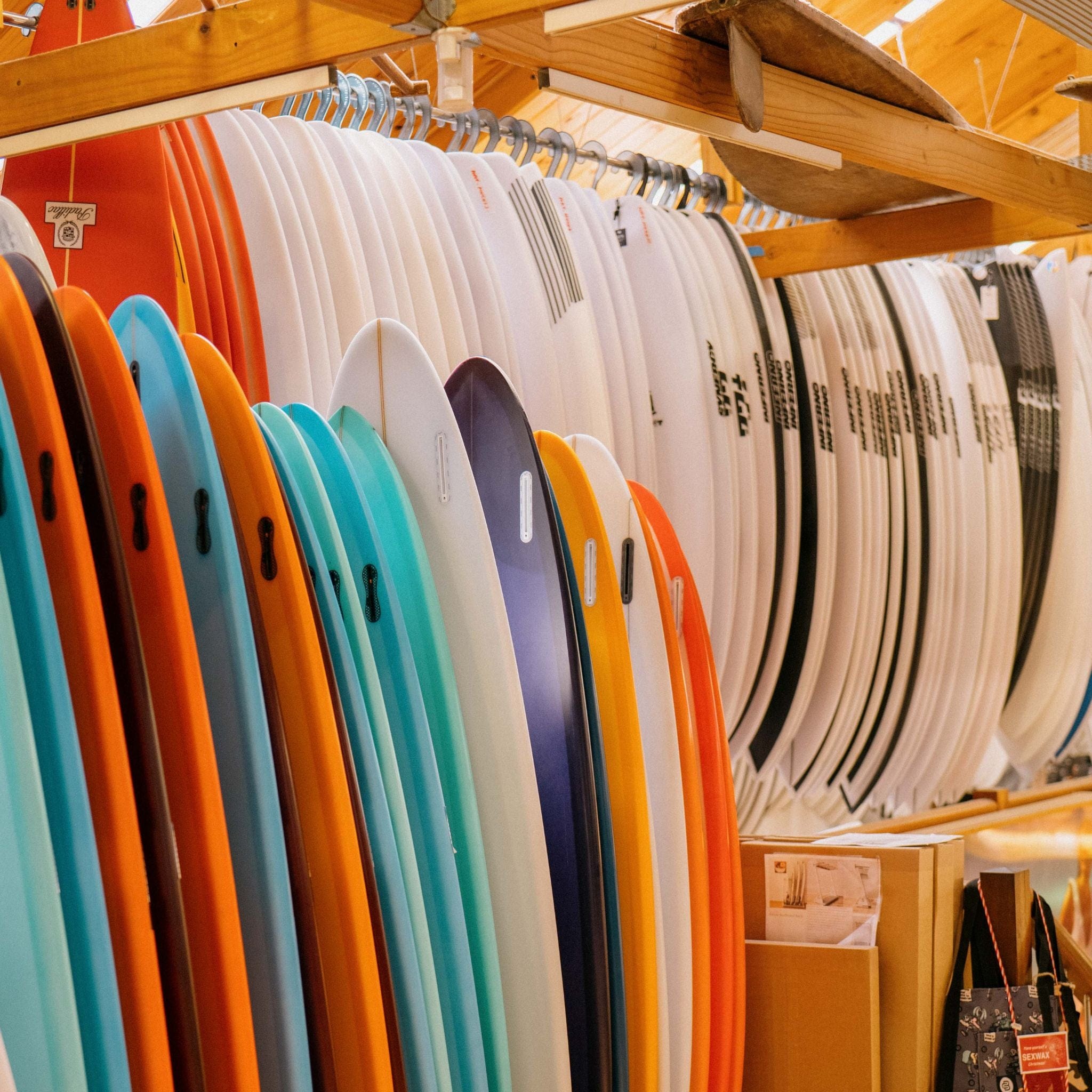
Surfboard lengths generally fall into a few categories:
- Longboards: 8’0” and up.
- Mid-lengths (fun shapes): around 6’8” to 8’0”.
- Shortboards: under 6’4”.
A great rule of thumb for beginner surfers is to choose a board that’s at least 2–3 feet longer than your height. The extra length and volume give you more paddle power, stability and confidence when catching waves in a crowded lineup.
Shorter boards with a pointy nose and sharp rails are for high-performance surfing. They’re a bad idea (i.e. waste of time and money) when you’re just learning.
Sure, you'll look cool taking it out of the boot and walking down the beach. But that means nothing when you can't even reach the lineup. The right board is the one that gets you more waves and makes you feel like you surf regularly.
Longboard
Longboards are the classic beginner go-to. Typically 8’0” to 9’6”, with rounded noses, wider outlines and thick rails, they provide plenty of volume and float. They can feel unwieldy, but the right one will ensure you catch more waves faster and level up quickly.
Pros for beginners:
- Ultra stable.
- Easy to paddle.
- Excellent for catching waves.
- Forgiving and smooth.
Cons for beginners:
- Less manoeuvrability.
- Heavier to carry.
- Slower on steep wave faces.
Browse our longboard collection.
Mid-Length Surfboard
Mid-lengths are the perfect middle ground between casual performance and ease of use. Ranging from around 6’8” to 8’0”, they combine good paddle power with more turning ability than a longboard.
Pros for beginners:
- Your wave count will be super high.
- More agile than a longboard.
- Ideal for smaller waves to medium waves.
- Go well in good conditions and mush.
Cons for beginners:
- Slightly harder to balance on compared to longboards.
- Perhaps too performance-oriented if you're new to surfing.
Browse our mid-length surfboards.
Shortboard
Shortboards (under 6’4”) are sleek, thin and built for high-performance surfing. They’re fast, reactive and suited to experienced surfers.
Pros for beginners:
- None, really.
- These are not the right shape for true beginners.
Cons for beginners:
- Hard to paddle.
- Difficult to catch waves.
- Very unstable.
- Require better skills and strong fitness.
Shortboards are tempting, but a small board will only make your learning curve steeper. Browse our shortboard surfboards.
Why Surfboard Volume is Really Important
Surfboard volume (measured in litres) tells you how much foam is in the surfboard. It’s calculated using length, width and thickness. And it plays a big role in your success.
- More volume = easier paddling, more float, more stability.
- Less volume = harder paddling, less stable, more agile.
As a beginner, your goal is to build confidence, catch more waves and spend more time upright. Choosing the ideal surfboard volume helps you do all of that by making the board easier to paddle and more stable once you’re up.
Our Surfboard Recommendation for Beginners
If you’re just getting into surfing, a softboard (aka soft-top or foamie) is the ultimate beginner-friendly choice. These boards are usually made with epoxy resin and soft foam construction, making them:
- Safer.
- More forgiving.
- Designed to help you catch waves easily.
- Lighter and therefore easier to carry.
Softboards are generally wider, thicker and have more volume than hardboards of the same length. This makes them easier to learn on. Browse our full softboard collection.
FAQ
What size board should I get as an intermediate surfer?
An intermediate surfer can size down from a longboard to a mid-length or epoxy surfboard, depending on surf conditions and skill level. Aim for enough volume to catch waves easily but with added manoeuvrability.
Are shorter boards harder to ride?
Yes. Shorter boards have less volume, making them harder to paddle, balance on and ride... especially in flat sections or smaller, mushier waves.
Can the same length boards have different volumes?
Absolutely. Two boards of the same length can have different widths and thicknesses, which affects the overall board volume and performance.
Should I choose a bigger board if I surf occasionally?
Yes. If you’re someone who only surfs occasionally, you’ll benefit from a larger board that offers more paddle power, stability and helps you enjoy more waves.
Final Thoughts
When it comes to choosing the best surfboard as a beginner, think less about style and more about stability, volume, and ease of paddling. Bigger boards help you progress faster, stay safer and have more fun. Your surfboard choosing journey should be guided by your surfing style, fitness, body weight and the surf conditions you’ll most often encounter.
Explore our full surfboard range here and find the right surfboard for your journey.